
Dressing stories: Jenny Beavan on crafting character through costume

By Oliver Webb

(Images courtesy of Jenny Beavan)
Across a career spanning more than four decades, costume designer Jenny Beavan has helped define the look of films such as The Remains of the Day, The King's Speech, Sense and Sensibility, Sherlock Holmes and Mrs Harris Goes to Paris. Beavan’s work has earned 12 Academy Award nominations, and three Oscar wins for A Room with a View, Mad Max: Fury Road and Cruella, cementing her place as one of the most celebrated costume designers working today.
Yet Beavan didn’t always plan a career in costume design. “In truth, I wanted to be a theatre designer,” she begins. Beavan first fell in love with theatre when she was 10 after her grandfather took her to see her first Shakespeare play.
“It was Twelfth Night starring Dorothy Tutin,” says Beavan. “I thought it was just the most magical thing I’d ever seen. The whole idea of a girl dressed up as a boy and the stage, the lights, all of it. I knew I wanted to be part of it someway or other.”
Beavan attended Central School of Art and Design in London where she studied with the theatre designer, Ralph Koltai. “He very much believed in not worrying about the costume as you’ll always get someone else to do them, which I thought was fine because I just liked making worlds. I like making the characters to go in my sets, but I was primarily a set designer and that's what I really wanted to do.”
Beavan stumbled into costume design by chance through a friend she grew up with. Her friend knew the duo James Ivory and Ismail Merchant. “They needed some costumes to put together for Peggy Ashcroft to go out to India,” says Beavan. “She was playing an eccentric English art dealer in Hullabaloo Over Georgie and Bonnie's Pictures, travelling overland to a Maharaja. On the second visit, Peggy said, ‘my dear, we're getting on quite well now. I'm a little worried about going to India.’ She was 70 at the time, which seems very young to me now.”

Peggy Ashcroft was offered a first-class ticket but wanted to change it for two economies so Beavan could accompany her. “So, there I am, I end up in India and they think I’m a costume designer. That was it really and I worked on many Merchant Ivory films from there.”
According to Beavan, Merchant Ivory were on total shoestrings during the early productions. “This was a film commissioned by the South Bank Show. It wasn’t like some of the big films I’m doing now. It felt more akin to fringe theatre to be honest, but we were in India doing it on a film, rather than some back street in London in a church hall. I was a bit surprised when they really adopted me, at least Jim thinks he adopted me. He tells everyone that he didn’t bring me up to run around deserts with semi naked men, i.e. Fury Road. I had the most wonderful few years.”
Those formative years with Merchant Ivory also helped shape Beavan's understanding of what costume design could achieve. To Beavan, costume design is essentially storytelling. “Every bit of what we do is storytelling,” she says. “I love helping actors tell their characters’ stories, it feels very straightforward to me. It's pretty much the same with the set, you're telling whatever story you want to tell, but architecturally.”
On many of the Merchant Ivory films, Beavan’s co-designer was John Bright. “He was an absolute inspiration. He owns Cosprop, the costume house. He's probably one of the most knowledgeable people in the world on period clothing, and a very good designer in his own right. We joined forces on The Bostonians, the very first big period that I did. I did a lot with him and learned so much by just listening and watching. He's a brilliant cutter and maker. I'm adequate at most things. I’m a very good dyer, actually, but most things everybody else does far better than I do. With John it was really, an extraordinary experience. I'm very blessed. He's still a very good friend.”
In 2024, the Merchant Ivory documentary was released. “I was doing a Q&A with James and his frequent collaborators. Helena Bonham Carter said to him, ‘You know, Jim, you always sort of just let us do what we wanted.’ And he replied, ‘Well, you know, if you’ve got the right people and you really trust them, you let them get on with it.’ When you look at those films, they’re just extraordinary, but he was guiding them. Without him, there would not have been such insight into personalities and characters.”
Close collaboration with the director is integral to the costume design process. On A Room with a View, Ivory gave Beavan and Bright a collection of Alinari photographs. “They are a beautiful set of photographs of Florence, set around 1908, all around early century. Ismail also gave us a tourist guide of Florence, which was terribly useful because I’d never been before.”

Beavan also works closely alongside the cast to help bring the costumes to life. “Actors will bring something you may not have seen. They will have an opinion and their own body language and I love that collaboration. It all happens in the fitting. It’s when you put the clothes on them that normally you both know if something is right or not. The actor is paramount.”
Occasionally, Beavan has had to change a costume last minute. One particular memorable change was for Vanessa Redgrave’s character in Howard’s End. “It was the Fortnum’s scene when they go Christmas shopping. We'd seen her character in dark because she's pretty old and ill by then, and mainly women wear dark things, but she said, ‘Oh no, I think I should wear pale colours.’ So, we put her in the pale colours, and of course it worked brilliantly and she was absolutely right.”
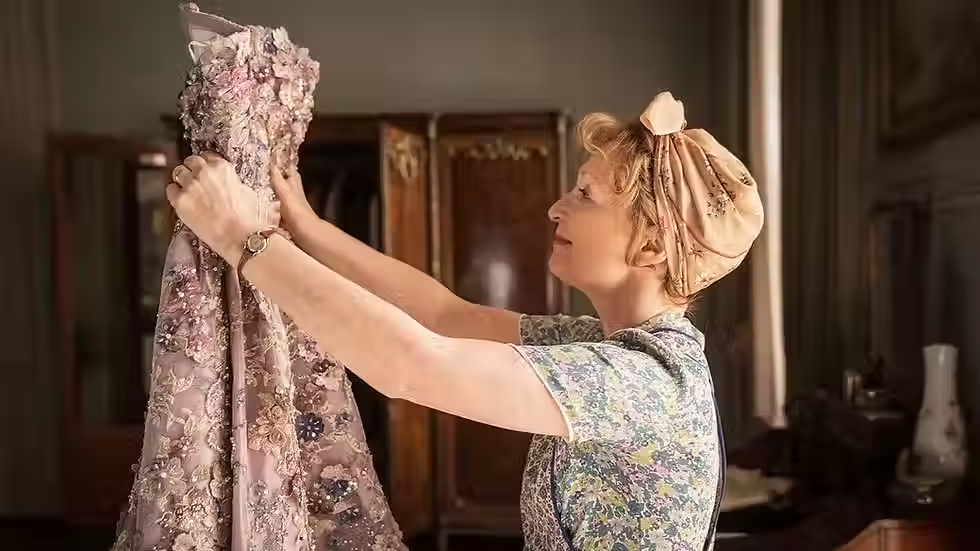
There are, however, a number of misconceptions that people have when it comes to costume design. “They think it's fashion, which it isn’t at all,” adds Beavan. “I couldn't be less interested in fashion unless I'm using fashion, i.e. in Cruella or Mrs. Harris goes to Paris, then I got fascinated by Dior. I found his whole workshop very interesting, as well as his sister, who was in the resistance, incredibly interesting. The clothes were fine. I thought they were great, but they didn't make me over excited, but they are beautiful and they are great shapes on women. It's just not my thing.”
For Cruella, Beavan enjoyed working on an origin story and didn’t feel in any way hampered by having to craft a specific look from the previous material. “Anthony Powell did 101 Dalmatians and was probably one of the greatest costume designers that ever lived,” she says. “I don’t think we did anything that looked like the Glenn Close film. We might have done the two who get the puppies in slightly the same brown colours that they are in in the animation, but I hardly looked at the animation. I prefer to come in fresh.”
Beavan believes that one of the mistakes some costume designers make is making it about themselves, i.e. people who put too much of their style into a specific project. “I think each piece should be totally appropriate to the piece, which doesn't mean it can't be incredibly stylish, but only if that's appropriate,” she explains. “People have said they can see that they're my costumes, but I'm hoping they can't. There’s just a huge amount more to it, and an awful lot now of PR politics, dealing with producers, budgets. Normally the supervisor does budget, but I'm always involved and I have to be responsible that I don't get people spending too much money if we don't have it.”
One of the many challenges of costume design is balancing historical accuracy and cinematic storytelling. Beavan prefers to be very accurate in her approach, as she argues that people then believe it. “For example, some American directors don’t like hats on women. In Jane Austen’s day, no women would even go out without a hat on, so to me a woman looks completely undressed if they don’t have a hat. They didn’t have sunblock and they were very keen to keep a pale skin. My grandmother died in the late 70s and she always wore a hat. That was part of what people did. When you think of Clint Eastwood in all those spaghetti westerns, looking absolutely amazing, the eyes coming out from under. Hats used properly are just brilliant, as long as they are used according to character.”
Although Beavan has worked on many period films, she admits that people were rather surprised when she decided to work on Mad Max: Fury Road. “I pointed out, that it's storytelling, but instead it’s in the apocalypse, not in 1800. It’s exactly the same; it’s just a different period and a different set of circumstances. George Miller is absolutely wonderful, not a word against George Miller.”
As part of her research, Beavan looked at a lot of African artists, including Dilomprizulike. “He makes incredible characters out of out of junk. African modern art was interesting too. Much of it came down to what we could find and what would have survived an apocalypse. There had to be a reason why the characters were wearing it. It didn't mean it couldn't be beautiful or interesting, but it had to have a reason and a purpose. George wanted to know what that purpose was, so we were very good at thinking our purposes.”
If given the opportunity to revisit any of the film’s she’s worked on, Beavan would redesign Alexander's wedding outfit for the 2004 film of the same name. “I did it too quickly,” she recalls. “I hadn't really got the hang of it. I thought I had to make the costume for earlier than I did and I could have taken a lot more time. It just looks a bit musical to me, as opposed to historical, because it was supposed to be a Bactrian wedding garment they would have, with gold coins because they used to sew all their wealth onto their clothing. I just kick myself for not taking longer. I tend to forget and move on from films. I'm sure there are things that would be I could have done better in the moment.”
Beavan is no stranger when it comes to fighting for creative choices. “I've had a couple of tricky experiences recently, one I won and one I didn't,” she says. “Sometimes it's best just walk away. I did a film years and years ago, and the director just wanted it to be all about him. Everything I presented him he didn't like, so I took to present him things I didn't like. When I started to change it, I changed up something I did like. You do play naughty games occasionally. I slightly got into that quite recently too and I thought, this is ridiculous, just walk away. You don't need this idiocy.”
Beavan acknowledges that she’s very much at a stage where she doesn’t need to work at the rate that she previously has. “I actually paid my mortgage off, it took me 50 years, but I did it. I don't actually have to work full time anymore. I can actually take breaks and not panic about it, which is an incredible experience.”
Every project Beavan works on is unique and over time, she has learnt not how to solve the problems, but how to approach them better. “When you think, oh my god, I've actually no idea what this should look like, you just sort of calm down and you have little rituals you do. Often it’s just more research. Then you could be in Sainsbury's, or in the bath, or wherever, and you have a light bulb moment because you really worked on it. That's a useful bit of knowledge I've gained, but you just learn all the time. I've now got a much bigger bank of stuff I can draw from.”
Pointing to costume designers she admires, Beavan notes that any of Piero Tosi’s work she finds inspiring, especially Death in Venice, Medea, The Leopard and all the Verdi operas. “Tosi was just extraordinary. Anthony Powell as well, for example his work on Tess. I loved Orlando that Sandy Powell did, there are stunning clothes in that. Those were the days when if you wanted it, you’d make it yourself and she’s a very good maker, unlike me. John Bright did beautiful things for Onegin for Martha Fiennes.”
What Beavan doesn’t like is noticing the costumes for the wrong reason. “I don't mind if it's The Adventures of Priscilla, Queen of the Desert because then you want to notice them. There's lots of films where you just want to look at the clothes, but there’s others where you feel they’ve been done too consciously and they just don’t quite work.”
Throughout her career Beavan has read many exciting scripts, but admits she particularly loved The Choral. She also lists Remains of the Day and The Gathering Storm as being among her favourites. As well as relying on a good script and story, Beavan is now more interested in working with people she both likes and respects.

“I'm not too bothered what period it is,” she says. “Although, I'm not so keen on contemporary. Too many people think they know all about clothes and there's too much choice out there.”
Beavan’s advice to young costume designers is to learn everything they can about the trade: from cutting, sewing, use of fabrics, types of fabrics, breaking down, aging, distressing, dying, organising and even where to have boots made. “Ultimately, you may prefer being an assistant, a buyer, or an ager/dyer and that's a very creative part of the job. A designer cannot do all of it.”
Beavan acknowledges that there is a conception that you're going to do a pretty drawing and then it suddenly happens. “You are kind of a mother figure, therapist, tea maker, soother, hugger,” she says. “Now I feel as if everybody's looking at me as if I'm mum and I'm very happy to be that. I do know what I'm looking at and doing, so I think they feel mum’s opinion is worthy.”
At the 2016 Academy Awards, Beavan made headlines after accepting her Oscar wearing a biker jacket, much to the disapproval of some attendees. "It was just a bit of fun and a homage to the film, but I was absolutely not going to wear some daft dress," she says. "I could never go on the red carpet at Cannes, because apparently women have to wear heels. What's that about?"
The reaction was perhaps fitting for someone who has spent a career resisting the idea that costume design is simply about fashion. For Beavan, clothes only matter when they serve a character and a story. As she puts it: "I couldn't be less interested in clothes until I'm telling stories and then I go for it 100%."


